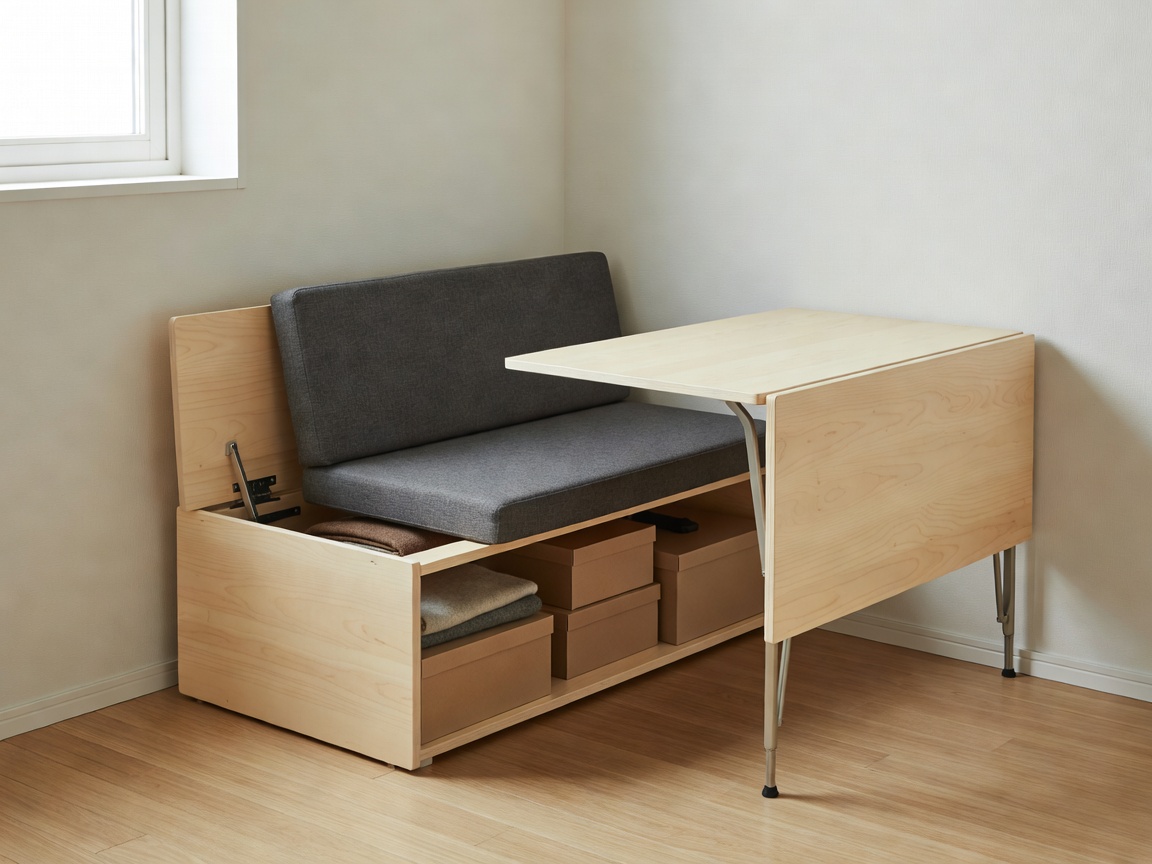
Count the jobs you need done
Make a short list of regular tasks before shopping. A storage bench might provide seating and a place for blankets; a folding table might support meals and occasional laptop work. If one of the functions is only a vague possibility, do not let it carry the same weight as an everyday need.
Consider whether the product performs each job comfortably. A narrow bench may store items yet be uncomfortable to sit on. A convertible sofa may save a separate guest bed but need enough clear floor area to unfold. Compare it with the simple alternatives, including owning fewer items or using a piece you already have.
Account for the changeover
Check the steps required to switch modes. Does the table need to be cleared first? Are there loose cushions or parts to store? Can one person transform it easily? The best design often makes the transition predictable and quick, without requiring the rest of the room to be rearranged.
Measure every state: folded, extended, open for sleeping, loaded with storage or in its usual working position. Include the space used by doors, lids and moving sections. If the space only works in one configuration, decide whether that is compatible with your household’s daily routine.
Keep essentials within reach
Hidden storage can be useful for occasional items, but everyday belongings should not become buried behind a transformation. Think about what is stored inside and how often you need it. If you must remove everything to use the main function, the product may solve one space problem while creating another.
Check construction and maintenance
Moving parts and combined functions deserve careful inspection. Read care instructions, assembly details and any stated load information. Check hinges, latches and surfaces for the way you expect to use them, and make sure the product can be cleaned in each configuration. Follow the maker’s directions and do not exceed stated limits.
A simple value test
Compare the floor area saved against the time and effort added. Note the footprint, number of genuinely useful functions, changeover steps, access to stored items and comfort for the main task. If it does not make the room easier to use, extra features alone are not a reason to keep considering it.